
The AI Engineer Roadmap: From Zero to Production
AI engineering isn't just prompt engineering. Here's a practical, no-fluff roadmap to becoming a production-ready AI engineer in 2025.
Zep Admin
May 3, 2026
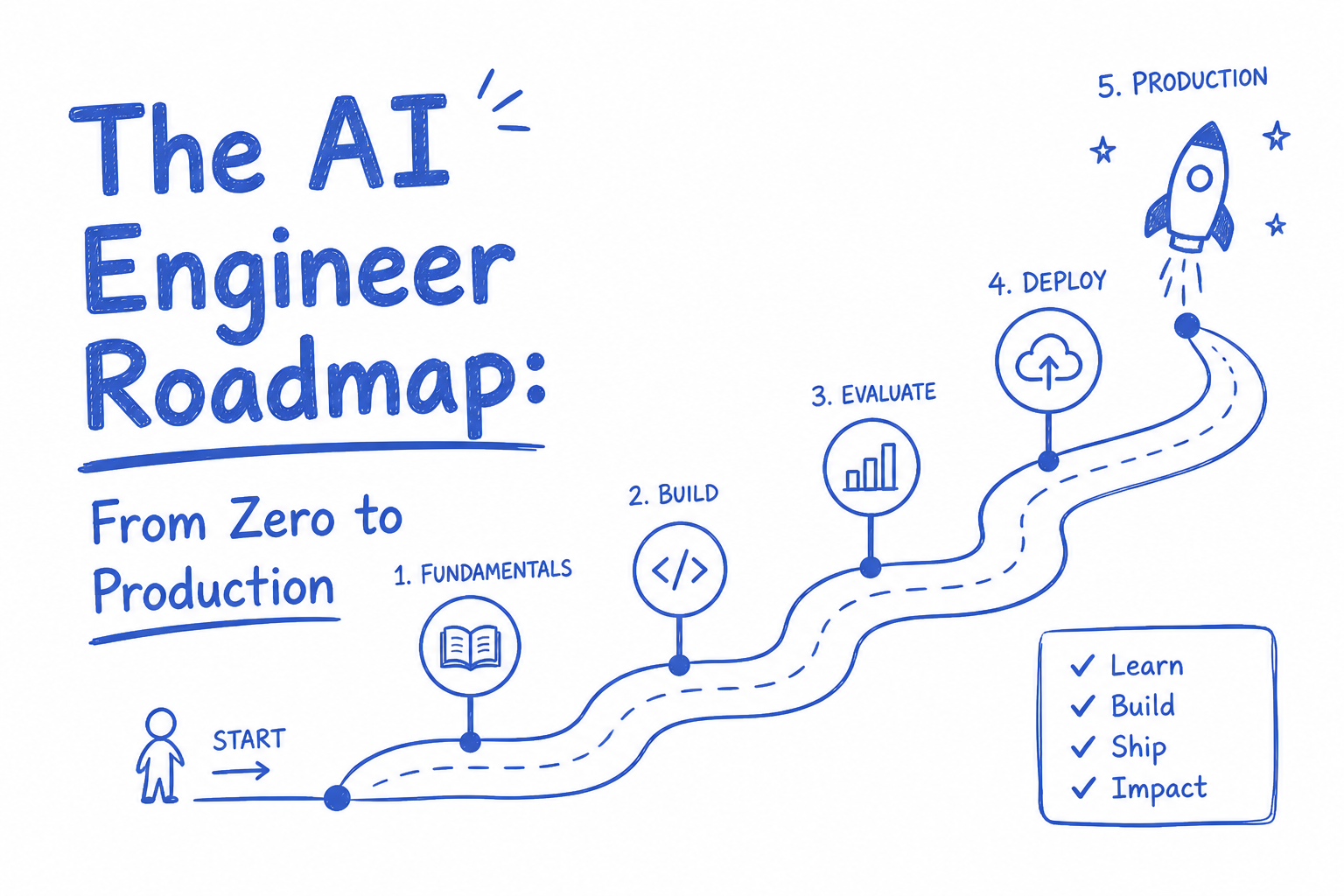
AI engineering isn't just prompt engineering. Unlike ML researchers who train models from scratch, AI engineers build on top of foundation models - wiring LLMs into apps, pipelines, and APIs that actually ship. Think: the person who takes GPT-4 or Claude and turns it into a customer support bot, a code reviewer, or a document analysis pipeline - with evals, observability, and production infra.
The 5 Pillars
1. Foundations Python & software engineering Strong Python, REST APIs, version control, async programming. You're still a software engineer first. Bonus: TypeScript if you ship web apps.
2. LLM fundamentals - how models actually work Attention, tokens, context windows, temperature, sampling. You don't need to implement transformers - but you need to know why a 200k context window is expensive and when RAG beats fine-tuning.
3. Prompt engineering & orchestration System prompts, few-shot examples, chain-of-thought, structured outputs. Tools: LangChain, LlamaIndex, or raw API calls. Learn when frameworks help and when they get in the way.
4. RAG, embeddings & vector databases Most production AI apps are retrieval-augmented. Learn chunking strategies, embedding models (OpenAI, Cohere, or open-source), and vector DBs like Pinecone, Weaviate, or pgvector.
5. Evals, observability & production The most underrated skill. Tracing (Langfuse, LangSmith), regression testing, hallucination detection, cost monitoring. AI in prod fails silently - you need to know when it's broken.
The honest truth about learning order
Most people start with tutorials, get excited, then get stuck the moment they try to build something real. The pattern that works:
- Build a chatbot on day one - even if it's terrible. Shipping forces you to learn the right things.
- Read one paper a week - not to implement it, but to know what's possible.
- Write evals before you optimize prompts. Otherwise you're flying blind.
- Fine-tuning is usually overkill. Reach for it only after you've exhausted prompt engineering and RAG.
Tools worth knowing in 2025
OpenAI API, Anthropic Claude, LangChain / LlamaIndex, pgvector / Pinecone, Langfuse, Hugging Face, Modal / Fly.io, Vercel AI SDK
The best AI engineers are product-minded. They don't just ask "how do I use this model" - they ask "is this the right solution for the user's problem at this cost?"