
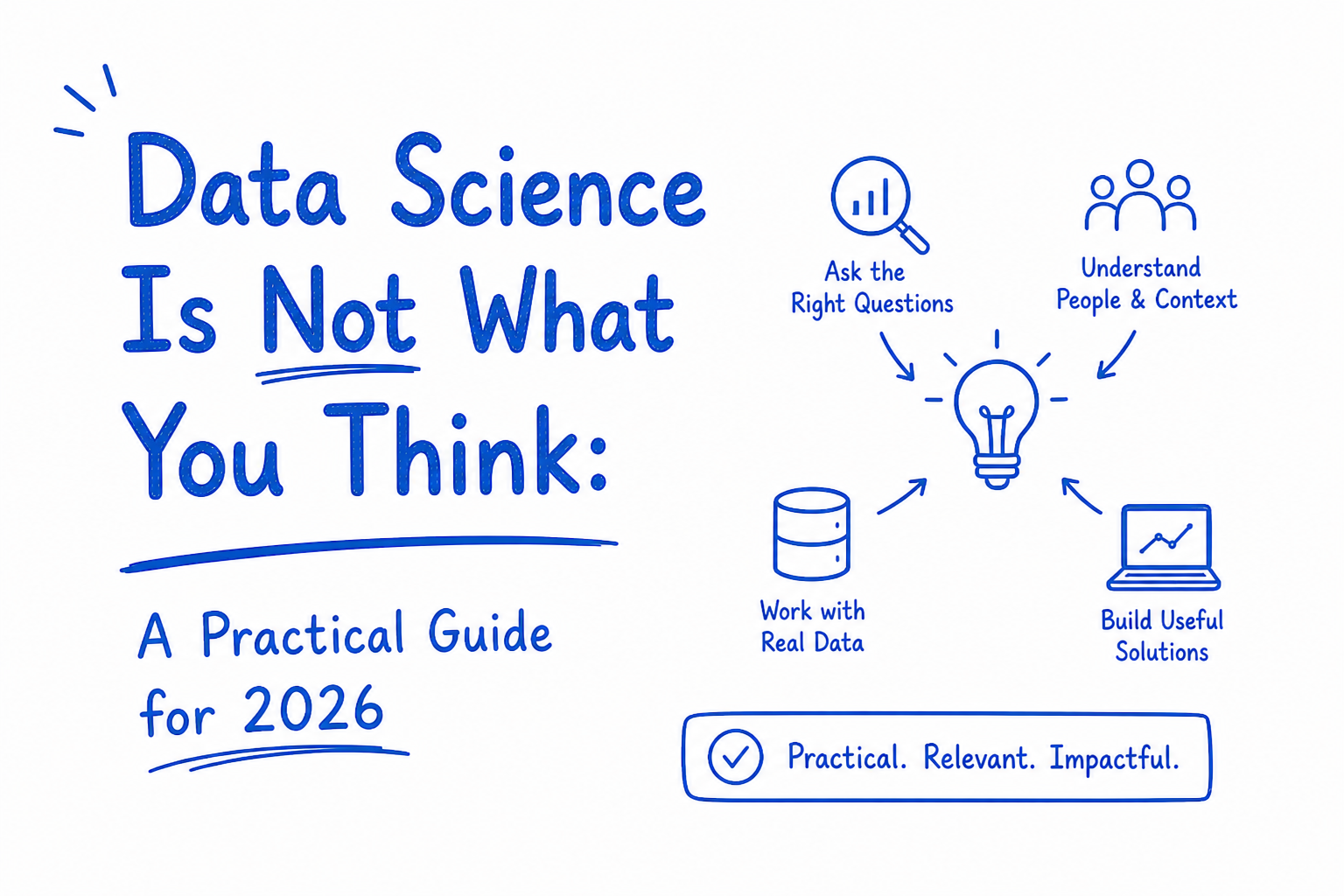
Most people learn data science to build models. Most data science jobs are 80% cleaning data and 20% explaining results to someone who doesn't trust them.
The sooner you accept that, the faster you'll get good.
What data science actually is
Data science is the practice of extracting decisions from data. Not just insights, not just pretty charts. Decisions. Revenue went down 12% last quarter, why, and what should we do about it? That's the job.
It sits at the intersection of three things: statistics (to understand what the data is saying), programming (to work with data at scale), and domain knowledge (to know which questions are worth asking).
You need all three. Being brilliant at one doesn't compensate for being weak at the others.
The core skill stack
1. Python (or R, but mostly Python) Pandas, NumPy, Matplotlib, Seaborn for day-to-day work. Scikit-learn for classical ML. You'll use these more than any fancy deep learning framework.
2. SQL Non-negotiable. Every data scientist pulls their own data. If you can't write a window function or a multi-table join without Googling, you're going to be slow. Practice until it's automatic.
3. Statistics and probability Distributions, hypothesis testing, p-values, confidence intervals, Bayesian thinking. Not to pass interviews. To not draw wrong conclusions from your own analysis.
4. Machine learning fundamentals Linear and logistic regression, decision trees, ensemble methods (XGBoost is everywhere), clustering, and dimensionality reduction. Understand the math well enough to know when a model is lying to you.
5. Data wrangling and cleaning Missing values, outliers, type mismatches, duplicate rows, inconsistent categories. Nobody talks about this because it isn't glamorous. It's also where most projects succeed or fail.
6. Communication and visualization A correct analysis that no one understands is useless. Learn to tell stories with data. Matplotlib and Seaborn for code, Tableau or Looker for stakeholders.
The learning order that actually works
Start with SQL. Get comfortable pulling and aggregating data before you ever touch a model. Then learn Python basics alongside Pandas. Build small projects: analyze a dataset you actually care about, answer a question that interests you.
Then pick up statistics in parallel with ML, not after. Reading about distributions while also training your first classifier makes both click faster.
Skip deep learning until you've shipped at least two end-to-end projects. Most real data science doesn't need neural networks.
The tools you'll actually use at work
- Notebooks: Jupyter, Google Colab for exploration
- Version control: Git, always. Data science code is still code.
- Data pipelines: dbt, Airflow, or Prefect for production data workflows
- Cloud: AWS (S3, SageMaker), GCP (BigQuery), or Azure. Pick one and learn it well.
- Experiment tracking: MLflow or Weights & Biases when models get serious
- BI tools: Tableau, Looker, or Metabase for stakeholder-facing dashboards
What separates good data scientists from great ones
Good data scientists build models that work. Great ones ask whether a model was even the right solution. They know when a simple heuristic beats a complex ML pipeline. They understand the business well enough to frame the right question. And they can communicate findings to a VP who has never heard of a confusion matrix.
Curiosity matters more than credentials. The best analysts I've seen are people who genuinely cannot leave an anomaly alone until they understand it.
Common traps to avoid
- Tutorial hell: endlessly learning tools without building anything real. Set a deadline and ship something.
- Model obsession: spending weeks tuning hyperparameters when better data would have solved it in a day.
- Ignoring deployment: a model that lives in a notebook is not a data science project. It's a draft.
- P-hacking: running enough tests until something looks significant. Know what it is. Know why it's dangerous.
Data science done right doesn't just describe the past. It changes what happens next.